
AI agents are reshaping healthcare by tackling complex challenges across diagnostics, treatment planning, administrative workflows, and patient engagement. They improve accuracy, enhance outcomes, and reduce operational inefficiencies. This chapter explores key applications—including clinical decision support, predictive analytics, drug discovery, and gene editing—and highlights innovations like AI-driven sepsis management, TrialGPT, AlphaFold 3, and CRISPR-GPT. These technologies integrate seamlessly into healthcare, enabling precision, scalability, personalized care, and preventive strategies while addressing global health disparities.
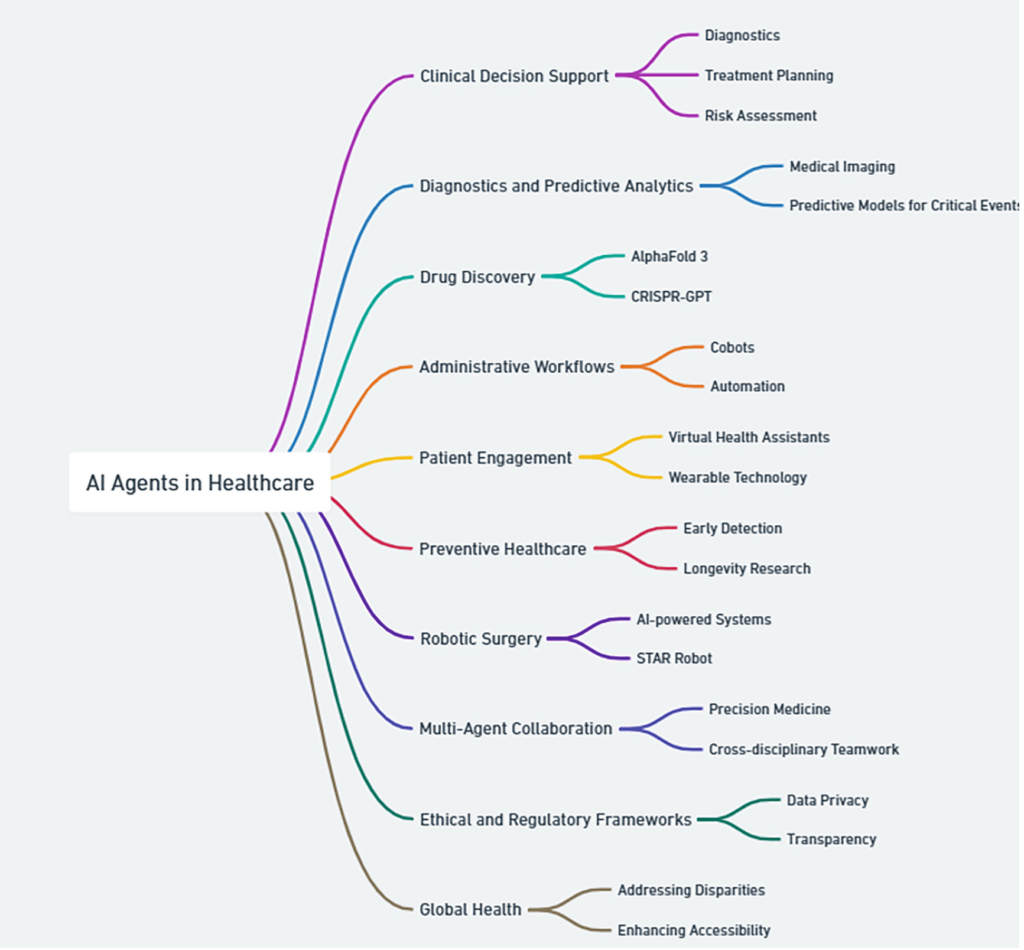
This figure provides an overview of AI applications in healthcare, from clinical decision support to global health initiatives.
Table of Contents
1. Applications of AI Agents in Healthcare
AI agents revolutionize healthcare by enabling efficient, accurate, and scalable solutions in diagnostics, drug discovery, clinical workflows, and administrative operations.
1.1 Clinical Decision Support
AI enhances diagnostic accuracy, treatment planning, and risk assessment in real-time, high-stakes environments like ICUs.
- Sepsis Management: Multi-agent systems monitor vitals, analyze labs, and recommend treatments. Borkowski and Ben-Ari (2024) describe specialized agents collaborating autonomously to optimize sepsis care, reducing diagnostic variability and improving outcomes.
- TrialGPT: Streamlines clinical trial recruitment with three modules—Retrieval, Matching, and Ranking—improving efficiency by 42.6% and matching accuracy to human experts. TrialGPT also provides transparent explanations and scalable deployment, though further validation is ongoing.
1.2 Diagnostics and Predictive Analytics
AI improves early disease detection and anticipates complications using machine learning, computer vision, and NLP.
- Diagnostics: AI tools in medical imaging, like Google Health’s breast cancer detection system, match radiologist performance and accelerate clinical adoption.
- Predictive Analytics: Systems like COMPOSER predict sepsis, respiratory failure, and cardiac events by analyzing EHRs, vitals, and labs. Early alerts improve intervention timing and reduce morbidity and mortality.
1.3 Drug Discovery
AI accelerates drug development by modeling molecular interactions and optimizing therapeutics.
- AlphaFold 3: Predicts protein structures and interactions with DNA, RNA, ligands, and ions, streamlining drug target identification. Integration with platforms like Isomorphic Labs enhances therapeutic discovery globally.
1.4 Gene Editing
AI agents enable precise DNA modifications for disease treatment.
- CRISPR: Tools like CRISPR-GPT assist in designing, planning, and executing gene-editing experiments, automating complex tasks for researchers of varying expertise.
- Applications: Include correcting genetic disorders (e.g., sickle cell), engineering CAR-T cells for cancer therapy, and disrupting HIV receptors.
- CRISPR-GPT Modes: Meta Mode (predefined workflows), Auto Mode (customized pipelines), Q&A Mode (interactive guidance), enabling flexible, accessible gene-editing design.
1.5 Administrative Workflows
AI reduces healthcare costs by automating billing, scheduling, and record management.
- Cobots: Collaborative robots handle up to 60% of administrative tasks, freeing providers to focus on patient care (Vennaro, 2024).
- Broader Impact: Integration with RPA and analytics streamlines operations and supports clinical tasks like diagnosis and medication management.
1.6 Enhancing Patient Engagement
AI improves patient interaction through virtual health assistants (VHAs) and chatbots.
- Example: Diabetes management chatbots increased patient confidence, satisfaction, and improved glycemic control (Magee et al., 2022).
- Benefit: Personalized education and monitoring enhance adherence and engagement.
1.7 Preventive Healthcare and Longevity Research
AI enables proactive, personalized care by analyzing genetics, lifestyle, and medical history.
- Preventive Care: Identifies high-risk patients for timely interventions. AI imaging tools enhance early disease detection.
- Longevity Research: AI predicts biological age and evaluates anti-aging therapies. Retro Biosciences, for instance, leverages AI to develop interventions for Alzheimer’s and cellular rejuvenation (Financial Times, 2025).
2. Future Directions
AI in healthcare is still emerging, but its potential is immense. Key future directions include:
2.1 Wearable Devices and IoT Integration
AI combined with wearables and IoT enables continuous monitoring, personalized treatment, and proactive care. Devices like Empatica’s Embrace smartwatch detect seizures in real time, while Samsung’s Galaxy Ring tracks heart rate, sleep, and respiration to deliver personalized wellness insights. AIoT systems process sensor data to detect anomalies, predict conditions, and guide interventions. Applications include human activity recognition for chronic disease management, fall detection, and preventive healthcare with smart glucose monitors and heart-monitoring devices. Future advances may include implantable sensors, real-time genetic analysis, and edge computing for rapid, precise, and ultra-personalized care.
2.2 Robotic Surgery
AI-powered robotic systems enhance surgical precision. The da Vinci Surgical System provides dexterity for minimally invasive procedures, while the STAR robot can autonomously perform soft tissue surgeries. Future AI-driven robots may handle semi- or fully autonomous surgeries, adapt to intraoperative challenges, and integrate multimodal data for hyper-personalized procedures, expanding access to expert surgical care.
2.3 Multi-agent Collaboration in Healthcare
Advanced multi-agent systems will coordinate diagnostics, treatment planning, and care delivery across specialties. They can aggregate genomics, proteomics, and clinical trial data to accelerate precision medicine, optimize patient outcomes, and streamline collaboration between clinicians, researchers, and policymakers.
2.4 AI Agents in Genomics and Multi-omics Integration
AI will integrate genomics, transcriptomics, proteomics, and metabolomics with clinical data to identify disease biomarkers and tailor treatments. Real-time multi-omics analysis will enable highly personalized therapies and accelerate drug discovery.
2.5 AI Agents in Mental Healthcare
AI-driven chatbots and virtual assistants provide accessible, personalized mental health support. Tools like Woebot offer cognitive behavioral therapy, mood tracking, and psychoeducation, complementing traditional therapy. AI can also detect early signs of depression or anxiety, enabling timely interventions, though human therapists remain essential for complex cases.
2.6 Ethical and Regulatory Frameworks
Future frameworks will ensure transparency, accountability, and fairness while addressing data privacy, algorithmic bias, and autonomous decision-making. Adaptive regulations and international cooperation will balance innovation with patient safety and equitable access.
2.7 AI in Global Health
AI can expand healthcare access and equity in low-resource settings through telemedicine and mobile health platforms. Large-scale data analysis will improve outbreak prediction, resource allocation, and public health policy. AI will also facilitate international collaboration to address global health challenges, including pandemics, antimicrobial resistance, and climate-related health impacts.
3 Summary
AI agents are transforming healthcare across diagnostics, treatment, research, administration, and patient engagement. Multi-agent frameworks and tools like TrialGPT improve clinical decision-making and patient outcomes, while predictive analytics anticipate critical events. AI-powered diagnostics, such as Google Health’s breast cancer model, demonstrate precision in imaging, and innovations like AlphaFold 3 and CRISPR-GPT accelerate drug discovery and gene editing. Automation enhances administrative efficiency, and virtual assistants and wearables improve patient engagement. Future developments in genomics, robotics, IoT, mental health, and global health, guided by ethical frameworks, promise personalized, equitable, and highly efficient healthcare worldwide.