
Keywords: Multi-agent systems (MASs), Agent coordination, Communication protocols, Conflict resolution, Agent specialization, Human-agent collaboration, Distributed AI, Capability levels of agents
Imagine a swarm of drones seamlessly coordinating a breathtaking aerial light show or a city’s traffic grid intelligently adapting to real-time conditions, minimizing congestion and maximizing flow. These are not futuristic fantasies but glimpses into the rudimentary capability of multi-agent systems (MAS)—a transformative field where autonomous AI agents collaborate to solve complex problems far beyond the capabilities of any single entity. Chapter 1 painted a vision of the AI agent revolution, and Chap. 2 delved into the building blocks of these intelligent agents. Now, in this chapter, we explore how these agents interact, coordinate, and collectively achieve remarkable feats. This chapter dissects the intricacies of MAS, from the fundamental principles of agent communication and coordination to the challenges of conflict resolution and the design of robust, scalable systems.
Table of Contents
1. Introduction to Multi-Agent Systems (MASs)
Multi-Agent Systems (MASs) are AI ecosystems where multiple intelligent agents interact to achieve individual or collective goals. Each agent operates autonomously, handling specialized tasks independently, yet MASs rely on collaboration and coordination among agents when needed. This combination of autonomy and cooperation allows MASs to solve complex problems that would be difficult or impossible for a single AI. Agents are both reactive and proactive: they respond to changes in real time while pursuing long-term objectives, creating a balance between immediate responsiveness and goal-directed behavior.
In practical terms, MASs can represent robots in a factory, vehicles in a traffic system, or even abstract entities like trading strategies in financial markets. Unlike single-agent systems, where complexity comes from the agent itself, MAS complexity emerges from the interactions between multiple agents. Single-agent systems are simpler, cost-effective, and ideal for focused tasks such as basic customer support or content generation. MASs, on the other hand, excel in scenarios that require coordination, specialization, and scalability. Table 1 highlights the main differences between single-agent systems and MASs, illustrating how MASs handle complexity, communication, and fault tolerance through collaborative agent interactions.
| Aspect | Single-Agent System | Multi-Agent System |
|---|---|---|
| Autonomy | Operates independently | Requires coordination and collaboration |
| Complexity | Simple to design and manage | Emerges from agent interactions |
| Scalability | Limited | Highly scalable through distributed agents |
| Communication | Minimal or none | Essential for information sharing and negotiation |
| Fault Tolerance | Low; system fails if agent fails | High; system resilient to individual failures |
| Example | Robot pathfinding in a maze | Traffic management with multiple autonomous vehicles |
The advantages of MASs include enhanced problem-solving capabilities, scalability, and robustness. By leveraging diverse agent capabilities, MASs can tackle intricate tasks like supply chain management, healthcare coordination, or smart city operations. Their distributed nature ensures the system can continue functioning even if some agents fail. However, MASs face challenges such as ensuring effective communication between agents, balancing autonomy with coordinated action, and managing conflicts over shared resources through negotiation and decision-making protocols. Despite these challenges, MASs offer a powerful framework for complex, dynamic, and collaborative AI solutions.
2. Coordination Techniques in Multi-Agent Systems
The effectiveness of Multi-Agent Systems (MASs) depends heavily on how agents coordinate. Coordination techniques help agents work together efficiently, resolve conflicts, and achieve collective goals that would be difficult for a single agent to accomplish.
One widely used approach is negotiation. The Contract Net Protocol, introduced by Reid G. Smith in 1980, allows a manager agent to announce a task while contractor agents submit bids to complete it. The manager assigns the task to the most suitable agent based on these bids. Auction-based methods, such as English or Vickrey auctions, are also common, particularly for resource allocation problems. More sophisticated negotiation approaches incorporate game theory and decision-making models, allowing agents to reason about each other’s strategies for more effective outcomes.
Coordination also relies on cooperation mechanisms. Agents achieve synergy through shared mental models, task decomposition, and collaborative planning. By aligning their understanding of goals and roles, agents can anticipate each other’s actions and divide complex tasks into subtasks. Frameworks like AutoGen and CrewAI demonstrate advanced task decomposition and planning, enabling specialized agents to collaborate dynamically, distribute workloads efficiently, and adapt to changes in real time. Collaborative planning often involves iterative proposal, critique, and refinement to reach mutually acceptable solutions.
Competition strategies also play a role in MASs. Market-based approaches simulate resource competition among agents, while adversarial search techniques, used in game-playing AI, allow agents to optimize their outcomes in competitive scenarios. Real-world MASs often combine cooperation and competition, a concept known as “coopetition,” to balance individual goals with system-wide objectives.
Task allocation and resource sharing are critical for MAS performance. Centralized approaches assign tasks from a global perspective, while decentralized methods allow agents to make local decisions. Hybrid methods combine both, using hierarchical task networks or token-based resource-sharing systems to optimize efficiency and robustness.
Evaluating MAS coordination frameworks involves criteria such as coordination models, task allocation, communication protocols, conflict resolution, scalability, and behavioral coherence. Table 2 summarizes how four prominent frameworks—AutoGen, CrewAI, LangChain, and LlamaIndex—perform across these criteria.
| Criterion | AutoGen | CrewAI | LangChain | LlamaIndex |
|---|---|---|---|---|
| Coordination Models | Hybrid | Decentralized | Decentralized | Event-driven |
| Task Allocation | Dynamic, iterative | Role-based, negotiated | Predefined workflows | Event-triggered |
| Communication Protocols | Robust (sync/async) | Flexible (event-driven) | Limited | Event-centric |
| Conflict Resolution | Iterative, negotiation | Protocol-based | Developer-defined | Minimal |
| Scalability & Adaptability | Modular, highly scalable | Role-based, scalable | Scales in LLM contexts | Scales in data contexts |
| Behavioral Coherence | Strong alignment | Defined roles/workflows | Developer-dependent | Data-focused |
From this comparison, AutoGen emerges as the most versatile for dynamic, complex MASs, while CrewAI excels in structured, role-based systems. LangChain and LlamaIndex are better suited for specialized workflows like LLM processing or data handling but lack comprehensive multi-agent coordination features.
3. Communication in Multi-Agent Systems
Communication is the foundation of Multi-Agent Systems (MASs), enabling coordination, collaboration, and the emergence of collective intelligence. Unlike simple data exchange, agent communication involves structured interactions that support autonomous decision-making and collaborative problem-solving. Fundamental communication models include point-to-point messaging for direct exchanges, broadcast messaging for system-wide updates, and multicast messaging for targeted groups of agents. Communication patterns often follow request-reply, publish-subscribe, or event-driven architectures, allowing agents to interact synchronously or asynchronously depending on the task. Messages are structured to include sender and receiver identifiers, message type, content, metadata, and conversation identifiers, ensuring clarity and traceability (see Figure 3.1 for communication patterns).
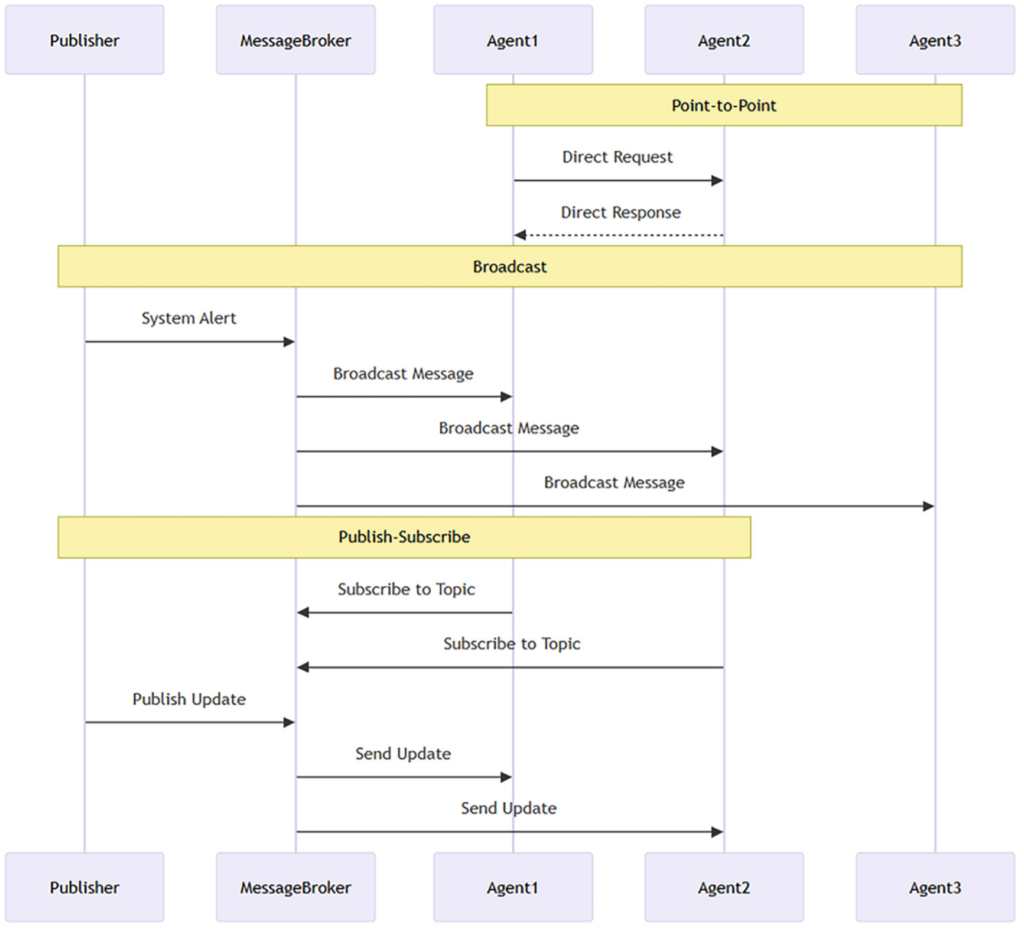
Agent Communication Languages (ACLs) provide the semantic and syntactic framework for meaningful interactions. The FIPA-ACL standard defines performatives such as inform, request, and propose, enabling agents to share knowledge, solicit actions, and negotiate solutions. KQML introduced many foundational concepts in this space, emphasizing extensibility, layered architectures, and knowledge sharing between agents. These languages allow MASs to go beyond mere messaging and engage in rich, intentional exchanges.
Transport and routing mechanisms ensure reliable, scalable communication. Asynchronous methods, such as message queues, event buses, and publish-subscribe middleware, provide persistence and fault tolerance. Routing strategies include direct, content-based, topic-based, and semantic routing. Modern protocols like WebSockets, gRPC with Protocol Buffers, and REST APIs support real-time, efficient, and cross-platform communication, each with trade-offs in latency, resource usage, and scalability.
Semantic frameworks add another layer of sophistication. Ontologies and domain-specific standards, such as HL7 in healthcare or FIX in finance, enable agents to share a consistent understanding of their environment. Semantic interoperability is further enhanced through ontology mapping, semantic bridges, and machine learning techniques, ensuring that agents can accurately interpret messages across heterogeneous systems.
Best practices for implementing agent communication focus on clarity, maintainability, and performance. Messages should have clear semantics, support versioning, and maintain backward compatibility. Protocols must be designed for scalability, load balancing, and fault tolerance. Avoiding overly complex message formats, ensuring robust error handling, and validating message integrity are critical to creating reliable, high-performing MASs.
4. Conflict Resolution in Multi-Agent Environments
Conflict resolution ensures harmonious operation among agents with diverse goals, capabilities, and perspectives. Conflicts in MASs can take several forms. Resource conflicts occur when multiple agents compete for limited system resources, such as robotic arms in a smart factory or bandwidth in networked systems. Goal conflicts arise when agents’ objectives contradict each other, like one traffic agent optimizing individual vehicle speed while another minimizes overall congestion. Belief conflicts happen when agents maintain inconsistent or contradictory information, as in distributed sensor networks, while plan conflicts occur when one agent’s intended actions interfere with another’s, such as multiple warehouse robots attempting to use the same aisle simultaneously (see Figure 3.2 for a conflict resolution state diagram).
Detecting conflicts early is critical. Plan analysis algorithms proactively examine agents’ intended actions for intersections or contradictions, often incorporating temporal reasoning to anticipate timing conflicts. Runtime monitoring continuously oversees agent behavior, using anomaly detection to flag emerging issues while balancing sensitivity to avoid false positives. Belief revision techniques maintain and cross-check agent knowledge, initiating information-sharing protocols when inconsistencies arise to ensure aligned decision-making.
Resolution strategies vary depending on conflict type and system requirements. Negotiation-based approaches are widely used, particularly for resource and goal conflicts. Agents can bid for resources, as demonstrated in the Python example below, where the highest bidder gains access to a shared resource:
class ResourceConflict:
    def __init__(self, resource_name):
        self.resource_name = resource_name
        self.bids = []
    def place_bid(self, agent_name, bid_value):
        self.bids.append((agent_name, bid_value))
    def resolve(self):
        winner = max(self.bids, key=lambda x: x[1])
        print(f"Resource '{self.resource_name}' allocated to {winner[0]} with bid {winner[1]}")
conflict = ResourceConflict("Shared_Resource")
conflict.place_bid("Agent_A", 50)
conflict.place_bid("Agent_B", 70)
conflict.place_bid("Agent_C", 65)
conflict.resolve()Other strategies include arbitration, where a neutral agent applies predefined rules to resolve conflicts quickly and fairly, and hierarchical frameworks, which handle local conflicts locally while escalating complex issues to higher levels. Adaptive approaches leverage machine learning to refine conflict management over time, predicting potential clashes and adjusting agent behavior proactively. Preventive strategies, such as careful resource allocation, clearly defined agent responsibilities, and robust coordination protocols, further reduce the likelihood and impact of conflicts. By combining detection, resolution, and prevention, MASs can maintain efficiency and coherence even in complex, dynamic environments.
5. Designing Multi-Agent Environments
Designing effective Multi-Agent Systems (MASs) requires careful consideration of architecture, agent roles, and system scalability. The architecture forms the foundation for agent interactions, communication, and coordination. Centralized architectures rely on a single controlling entity to oversee all agents, enabling global optimization but introducing potential single points of failure. Cloud-based infrastructures can mitigate these risks by distributing control functions across scalable platforms, as seen in smart city traffic management systems. Decentralized architectures distribute decision-making among agents, enhancing robustness and autonomy, though global performance may be suboptimal. Hybrid architectures combine both approaches, often using hierarchical structures where high-level decisions are centralized while local agent groups retain autonomy, balancing efficiency with flexibility.
Defining clear agent roles and specializations is critical in complex MASs. Functional specialization allows agents to develop expertise in particular tasks, such as diagnosis, treatment planning, or patient monitoring in healthcare systems. Hierarchical role structures manage complexity by assigning different levels of authority, while adaptive role assignment dynamically adjusts responsibilities based on system needs or agent performance. Balancing specialization with generalization ensures both efficiency and resilience in unpredictable environments.
Scalability and flexibility are achieved through modular system design, which allows agents to be added, removed, or upgraded without disrupting operations. Load balancing ensures that tasks are dynamically distributed based on agent capacity, while interoperability standards enable agents from different developers or system generations to work together seamlessly. Scalable data management techniques, such as distributed databases or data sharding, support performance in data-intensive applications. Evolutionary design approaches, leveraging machine learning or reinforcement learning, allow MASs to adapt and optimize over time. By combining thoughtful architecture, clear role definition, and scalable, flexible design, MASs can meet complex and dynamic operational requirements.
6. System Maintenance and Evolution
Maintaining and evolving Multi-Agent Systems (MASs) presents unique challenges beyond traditional software maintenance. Effective MAS maintenance ensures that agents remain operational, system performance is optimized, and knowledge is preserved over time.
Managing the agent lifecycle is critical. Deployment requires careful integration of new agents with existing ones, proper initialization of knowledge bases, communication protocols, and security credentials, and often a supervised trial period to ensure alignment with system objectives. For instance, new trading agents in financial systems may initially operate in simulation mode before handling real trades. Agent retirement is equally important: responsibilities must be handed off, tasks completed, connections cleanly terminated, and knowledge archived for future analysis, ensuring continuity and stability.
System health monitoring and diagnostics are essential for operational stability. Real-time metrics track communication latency, resource utilization, and queue depths, enabling rapid detection of performance issues. Layered diagnostic mechanisms, including agent-level heartbeats, network monitoring, and system-wide resource checks, provide comprehensive oversight. Automated responses, such as task redistribution, failover, or agent restart protocols, minimize disruptions, while intelligent alert systems prioritize critical events and reduce alert fatigue. Preventive monitoring leverages trend analysis, deviation detection, and behavioral observation to anticipate problems before they impact operations. Detailed operational logs support real-time analysis and post-incident review, ensuring informed decision-making.
Configuration and version management in MASs goes beyond traditional software practices. It involves tracking agent software, knowledge bases, interaction protocols, and behavioral rules, ensuring consistency across the system while supporting incremental updates, rollbacks, and dependency impact analysis. Changes must be carefully coordinated to avoid unintended effects on other agents.
Finally, documentation and knowledge management are crucial. Documentation must capture not only technical specifications but also inter-agent interactions, coordination strategies, and the reasoning behind architectural decisions. Knowledge management preserves system evolution history, incident responses, and lessons learned, providing valuable insight for debugging, planning updates, and understanding emergent behaviors. By maintaining comprehensive records, MASs can evolve safely and efficiently while retaining operational knowledge over time.
7. Evaluation and Benchmarking of MASs
Systematic evaluation and benchmarking are essential for understanding the effectiveness of Multi-Agent Systems (MASs), comparing different approaches, and guiding future development. Unlike traditional software, MAS evaluation must consider both individual agent performance and emergent, system-wide behaviors. Quantitative metrics such as task completion rates, resource utilization, and communication overhead are important, but they must be complemented by less tangible factors, including the quality of cooperation, effectiveness of conflict resolution, and system adaptability. For example, a multi-agent manufacturing system might be evaluated not only on throughput but also on how flexibly it handles unexpected orders or equipment failures. Qualitative assessment adds depth by examining the robustness of coordination mechanisms, the efficiency of information sharing, and the overall coherence of agent behaviors, often using expert analysis or scenario-based testing.
Benchmarking methodologies enable fair comparisons across different MAS implementations. Scenario-based benchmarking tests systems against predefined conditions, including normal operations, high-stress situations, and edge cases, evaluating both functional and nonfunctional attributes like scalability and resilience. Comparative benchmarking examines different architectures, coordination mechanisms, or decision-making algorithms under identical conditions, providing insight into the strengths and weaknesses of each approach.
Performance analysis techniques help reveal the complex dynamics of MAS interactions. Interaction analysis focuses on communication patterns, message flows, and coordination efficiency, often using visualization tools to track agent behaviors over time. Behavioral analysis examines how agents and the system as a whole respond to stimuli, including decision-making, learning, and adaptation processes. Understanding these dynamics is critical for optimizing system performance and achieving desired outcomes.
Finally, standardization and best practices ensure consistency and comparability across MAS evaluations. Standardized metrics assess aspects such as coordination efficiency, adaptability, and resource utilization, while clear documentation of test conditions, system configurations, and methodologies enables reproducibility. By combining rigorous evaluation, benchmarking, and adherence to standards, organizations can make informed design decisions, track improvements, and contribute insights that advance the broader field of multi-agent technologies.
8. Real-World Applications of MASs
Multi-Agent Systems (MASs) have demonstrated their potential in a wide range of real-world applications, primarily leveraging reinforcement learning or predictive AI for agent decision-making. While the integration of LLMs and generative AI in MASs is still emerging, rapid innovation suggests that new applications will soon arise.
Smart cities and urban management are prime examples of MAS deployment. In traffic management, agents representing traffic lights, vehicles, and central control systems coordinate to reduce congestion and optimize mobility. Singapore’s Intelligent Transport System, for instance, uses agents to monitor traffic in real time, dynamically adjusting signal timings and providing route recommendations, resulting in significantly improved traffic flow (ASEAN Post, 2018). In energy management, MASs balance supply and demand across power generation sources, distribution networks, and consumer devices. Amsterdam’s Smart City initiative employs agents to coordinate solar panels, electric vehicle charging stations, and smart meters, fostering a more sustainable energy ecosystem (Derrick, 2024). Waste management also benefits from multi-agent coordination; in Barcelona, sensor-equipped waste bins communicate with collection vehicle agents to optimize pickup schedules and routes, reducing costs and enhancing urban cleanliness (Sonnier, 2023).
Supply chain and logistics present another domain where MASs excel. Agents representing suppliers, warehouses, transport providers, and retailers coordinate to optimize inventory levels, predict demand, and manage the flow of goods. Walmart uses MASs to enable real-time inventory tracking and dynamic reordering across thousands of locations (Musani, 2023). Dynamic routing and load balancing for logistics are similarly enhanced through MAS coordination; DHL and FedEx employ agents to optimize delivery routes and reduce operational costs (Kamran, 2024). Collaborative planning, exemplified by Procter & Gamble, enables agents to share sales and inventory data with retailers, improving demand forecasting and reducing the bullwhip effect (Lafferty, 2018).
Disaster response and emergency management also leverage MASs effectively. Search and rescue operations use agents to coordinate human responders, drones, robots, and sensor networks, enabling rapid and efficient area coverage. DARPA’s LORELEI program illustrates this approach, deploying specialized agents for language processing, knowledge integration, machine learning, and user interface tasks to achieve situational awareness within 24 hours and evolve toward full language automation over days or weeks (Research Outreach, 2023). Similarly, the United Nations’ Humanitarian Data Exchange employs MASs to coordinate resource allocation during large-scale crises, matching medical supplies, food, and shelter to areas of need across multiple organizations (HDX, 2023).
9. AI Agents to Multi-Agent Systems: A Capability Framework
To understand the progression from individual AI agents to multi-agent systems, it is useful to examine agent capabilities across 11 levels, highlighting both functional complexity and multi-agent relevance.
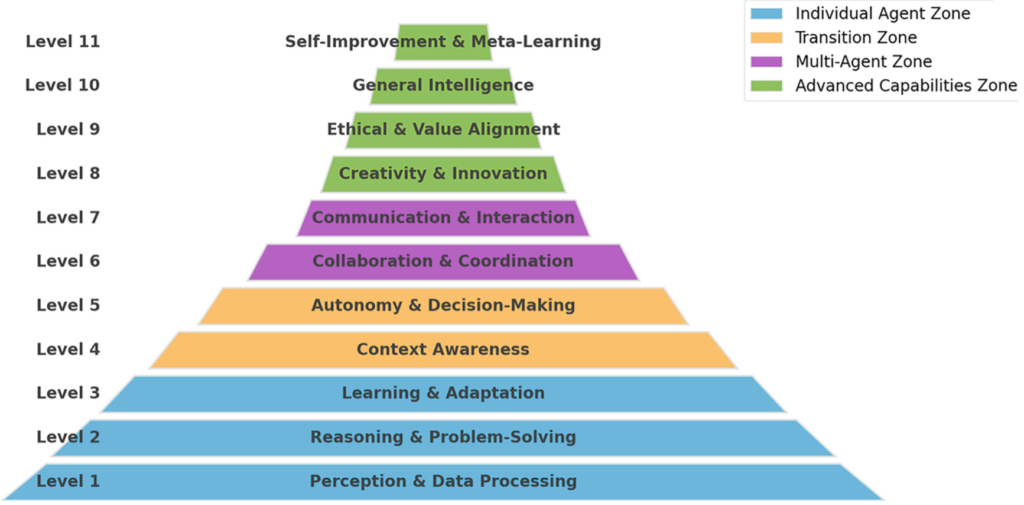
Level 1 – Perception and Data Processing focuses on an agent’s ability to process sensory inputs such as images, text, or audio, with metrics like recognition accuracy, precision, and efficiency. Multi-agent considerations are minimal at this stage. Level 2 – Reasoning and Problem-Solving emphasizes logical inference and structured problem-solving in well-defined environments, again primarily at the individual level. Level 3 – Learning and Adaptation introduces the ability to improve performance over time through supervised, unsupervised, or reinforcement learning, occasionally involving collaborative or competitive adaptation.
Level 4 – Context Awareness expands agent understanding to spatial, temporal, and social dimensions, with emerging multi-agent considerations in shared environments such as robotics or autonomous navigation. Level 5 – Autonomy and Decision-Making involves agents making independent decisions in dynamic environments, often within decentralized systems where interactions affect other agents. Level 6 – Collaboration and Coordination is the first level where MAS principles are central, requiring mechanisms for communication, task allocation, and conflict resolution, with performance measured in terms of team efficiency, robustness, and cooperative quality.
Level 7 – Communication and Interaction evaluates agents’ abilities to share information effectively, interpret intent, and maintain contextual relevance, critical in distributed planning or swarm intelligence. Level 8 – Creativity and Innovation addresses the generation of novel solutions, where MAS collaboration can produce emergent innovations. Level 9 – Ethical and Value Alignment assesses agents’ adherence to ethical norms, ensuring fairness, bias mitigation, and privacy, particularly important in collective behaviors. Level 10 – General Intelligence corresponds to AGI, with multi-agent considerations arising when general intelligence operates collaboratively. Level 11 – Self-Improvement and Meta-Learning involves agents refining their own architectures and strategies, where MASs may support collaborative optimization, though individual self-improvement remains central.
10. Build API for AI Agents in Multi-Agent Systems
Connecting AI agents securely and efficiently in a multi-agent system (MAS) often requires exposing agents as APIs. This section explores the rationale, key components, example endpoints, and considerations for API-based deployment of AI agents.
10.1 Why Expose an AI Agent as an API?
Exposing an AI agent as an API enables seamless integration, scalability, and automation. However, the decision depends on the agent’s functionality, interaction style, and deployment goals.
Benefits of API Exposure:
- Integration with Other Applications: APIs allow agents to interact with various systems, embedding specialized tasks like recommendations, predictions, or insights into multiple platforms.
- Scalability: APIs enable multiple applications to access agent capabilities without additional infrastructure, e.g., fraud detection agents integrated across several services.
- Developer Flexibility: Exposed APIs allow teams to build custom applications on top of the agent’s functionality.
- SaaS Offerings: APIs facilitate service-based models, allowing clients to access functionalities without managing the underlying infrastructure.
- Testing and Prototyping: Developers can validate agent logic or machine learning models under real-world conditions.
- Data Sharing and Analysis: APIs provide a conduit for insights to flow to other systems for analytics, reporting, and decision-making.
- Automation: APIs integrate agents into event-driven workflows, triggering actions or responses automatically.
Considerations Before API Exposure:
- Security: Exposing APIs increases attack surfaces, requiring authentication, authorization, encryption, and rate limiting.
- Complex Functionality: Agents that rely on rich conversational context may perform better embedded directly in a user interface rather than accessed via an API.
- Performance Overhead: Multiple concurrent API calls can introduce latency; scalability must be carefully planned.
- Cost and Maintenance: Hosting and maintaining API infrastructure adds computational and operational costs.
10.2 Key Components of an Effective API Specification
- API Structure and Communication Protocols: REST is suited for general-purpose operations, GraphQL for flexible queries, and WebSockets for real-time, event-driven multi-agent interactions.
- Authentication and Identity Verification: OAuth 2.0 with OpenID Connect, API keys, and JWTs enable secure access and identity management.
- Access Control and Authorization: Role-based access control (RBAC) defines user permissions, complemented by attribute-based access control (ABAC) for context-sensitive policies. API tokens should have limited scopes.
- Multi-Agent Communication: Assign unique IDs/namespaces for agents, maintain a registry of capabilities, support direct and broadcast messaging, and implement event-driven hooks for multi-agent workflows.
- Memory and Internal Tool Protection: Encrypt internal memory, control access via expiring tokens, and expose tools through proxy APIs to prevent unauthorized access.
- Security Measures: Rate limiting, encryption, audit logs, and intrusion detection are essential for robust API security.
- Error Handling and Feedback: Standardize error codes and messages, support retries, and offer fallback mechanisms for multi-agent workflows.
- Developer Tools and Documentation: Provide clear documentation, example requests/responses, SDKs, and sandbox environments for testing API integrations.
10.3 Example API Endpoints
Core Endpoints:
- Authentication & Identity:
POST /auth/token: Obtain access token.POST /auth/verify: Validate token and identity.
- Multi-Agent Communication:
GET /agents: List available agents and capabilities.POST /agents/{agent_id}/message: Send message to a specific agent.POST /broadcast: Broadcast message to multiple agents.
- Memory & Internal Tools:
GET /agents/{agent_id}/context: Access shared agent context securely.POST /tools/{tool_id}/execute: Execute a tool via secure proxy.
- Access Control:
GET /permissions: Retrieve permissions for the current token.POST /permissions/update: Modify permissions (admin only).
Additional Multi-Agent Endpoints:
- Agent Management: register, update, delete, query agent info and status.
- Task & Workflow Management: create tasks, assign/reassign tasks, delegate tasks, initiate and monitor multi-agent workflows.
- Negotiation & Coordination: initiate negotiation, monitor negotiation status.
- Monitoring & Logging: retrieve logs and performance metrics.
- Shared Knowledge Base / Blackboard: add, retrieve, update, or delete shared knowledge.
These endpoints enable dynamic agent registration, task orchestration, negotiation, monitoring, and collective knowledge sharing, forming the backbone of a flexible MAS API.
10.4 When to Expose an Agent as an API
- Interfacing with multiple systems.
- Transactional use cases (structured queries or commands).
- Modular service deployment (e.g., text analysis, translation).
- SaaS deployments for third-party access.
10.5 When Not to Expose an Agent as an API
- Context-heavy interactions requiring deep conversational memory.
- Agents closely tied to specialized user interfaces.
- Latency-sensitive scenarios where API overhead is unacceptable.
10.6 Alternatives to Full API Exposure
- Webhooks: Event-driven notifications without full API exposure.
- Messaging Interfaces: Integration with platforms like Slack or Teams for real-time dialogue.
- SDKs: Provide flexible, controlled interactions with external applications.
Ultimately, exposing an agent as an API should align with its role in the ecosystem, operational requirements, and user needs, balancing accessibility, security, and performance.
11. Future Directions in Multi-Agent Systems
The field of Multi-Agent Systems (MAS) is evolving rapidly, driven by advances in AI, computing, and human-computer interaction. This section highlights key future directions likely to shape the next generation of MAS.
11.1 Integration with Emerging Technologies
MAS are poised to benefit from cutting-edge technologies such as quantum computing, blockchain, and edge computing:
- Quantum Computing: Offers the potential to solve complex optimization problems at unprecedented speeds, improving MAS decision-making and coordination. Quantum algorithms could optimize resource allocation and task scheduling in dynamic multi-agent environments.
- Blockchain: Provides decentralized, tamper-proof mechanisms to enhance trust and security, crucial for autonomous agent negotiations and transactions. Immutable records can ensure reliable interactions, particularly in adversarial or distributed settings.
- Edge Computing: By placing computation closer to data sources, edge deployment reduces latency and improves real-time decision-making. MAS at the edge can respond more quickly in applications such as autonomous vehicles, industrial automation, and smart grids.
The synergy of MAS with these technologies promises enhanced scalability, efficiency, and applicability.
11.2 Human-Agent Collaboration
Future MAS will increasingly rely on agents that work seamlessly alongside humans. This includes collaborative robots, personal assistants, and industrial agents.
- Voice Agents: Natural language interfaces are becoming critical for human-agent interaction, offering intuitive, hands-free communication.
- Contextual Understanding: Agents must interpret human intentions, emotions, and linguistic nuances to respond appropriately. Sentiment analysis, domain-specific knowledge, and contextual reasoning are key enablers.
- Trust and Transparency: Explaining reasoning, providing consistent feedback, and demonstrating empathetic behaviors help build user trust.
- Personalization and Adaptability: Agents should learn user preferences and behaviors over time, adjusting recommendations and actions to enhance effectiveness.
- Practical Applications: Voice agents are particularly valuable in environments where traditional interfaces are impractical—such as industrial settings, autonomous vehicles, and healthcare—allowing seamless task execution and situational awareness.
11.3 Scalability and Robustness in Large-Scale MAS
Large-scale MAS, such as global logistics networks, smart cities, and planetary exploration, face challenges in complexity, heterogeneity, and unpredictability. Key considerations include:
- Decentralized Control: Local decision-making improves scalability, but mechanisms for global coherence—such as consensus algorithms and hierarchical structures—are essential.
- Robustness: Systems must handle agent failures, network disruptions, and adversarial attacks. Fault detection, redundancy, and self-healing capabilities will maintain system integrity.
11.4 Learning and Adaptation
Adaptive learning is crucial for MAS operating in dynamic environments:
- Reinforcement Learning: Enables agents to learn optimal strategies through trial and error.
- Federated Learning: Allows distributed agents to learn collaboratively without centralized data sharing, protecting privacy.
- Challenges and Solutions: Address exploration-exploitation trade-offs, large action spaces, multi-agent credit assignment, and communication overhead through hierarchical reinforcement learning and efficient protocols.
11.5 Multi-Agent Simulation for Complex Systems
Simulation remains vital for understanding and optimizing MAS:
- Applications: Ecosystems, economic markets, urban planning, and disaster response.
- Enhancements: High-fidelity modeling, real-time data integration, interactive interfaces, and immersive VR/AR environments.
- Benefits: Simulation enables exploration of emergent behaviors, testing of strategies, and informed decision-making in complex systems.
11.6 Beyond Traditional Paradigms
Future MAS will explore unconventional and hybrid approaches:
- Bioinspired MAS: Drawing from swarm intelligence and self-organization principles observed in nature.
- Neuroscience and Cognitive Science: Informing more intelligent, adaptive agent behavior.
- Hybrid AI Systems: Combining MAS with deep learning, symbolic reasoning, or other AI paradigms to leverage complementary strengths, enhancing robustness and versatility.
12. Summary
This chapter provides a comprehensive overview of multi-agent AI systems:
- Coordination Mechanisms: How agents negotiate, cooperate, and compete while managing resources and conflicts.
- System Architecture: Centralized, decentralized, and hybrid approaches for effective MAS design.
- Maintenance and Evaluation: Deployment, health monitoring, configuration management, benchmarking, and performance analysis.
- Real-World Applications: Smart cities, supply chains, and disaster response demonstrate MAS utility.
- Future Directions: Integration with emerging technologies, human-agent collaboration, scalability, adaptive learning, advanced simulation, and bioinspired/hybrid paradigms.
By addressing both foundational principles and emerging trends, the chapter equips readers with the knowledge to design, deploy, and innovate in the field of multi-agent AI systems.